
And like living stones be yourselves built into a spiritual house, to be a holy priesthood, to offer spiritual sacrifices acceptable to God through Jesus Christ. (1 Peter 2:5)
"Holy Orders is the sacrament through which the mission entrusted by Christ to his apostles continues to be exercised in the Church until the end of time…It includes three degrees of order: episcopate, presbyterate, and diaconate" (CCC 1536). Deacons, priest and bishops are essential to the Catholic Church because we believe that they continue the work begun by the apostles.
Since the beginning, the ordained ministry has been conferred and exercised in three degrees: that of bishops, that of presbyters, and that of deacons. The ministries conferred by ordination are irreplaceable for the organic structure of the Church: without the bishop, presbyters, and deacons, one cannot speak of the Church. (CCC 1593)
Ordination is the rite at which the Sacrament of Holy Orders is bestowed. The bishop confers the Sacrament of Holy Orders by the laying on of hands which confers on a man the grace and spiritual power to celebrate the Church’s sacraments.
The sacrament of Holy Orders is conferred by the laying on of hands followed by a solemn prayer of consecration asking God to grant the ordained the graces of the Holy Spirit required for his ministry. Ordination imprints an indelible sacramental character. (CCC 1597)
Who Receives Holy Orders?
The Church confers the Sacrament of Holy Orders only on baptized men (viri), whose suitability for the exercise of the ministry has been duly recognized. Church authority alone has the responsibility and right to call someone to receive the sacrament of Holy Orders. (CCC 1598)
In the Latin Church the Sacrament of Holy Orders for the presbyterate is normally conferred only on candidates who are ready to embrace celibacy freely and who publicly manifest their intention of staying celibate for the love of God's kingdom and the service of men. (CCC 1599)
The Second Vatican Council reminds us that the mission of ordained clergy, while unique, is interrelated to the mission of the lay faithful:
Though they differ from one another in essence and not only in degree, the common priesthood of the faithful and the ministerial or hierarchical priesthood are nonetheless interrelated: each of them in its own special way is a participation in the one priesthood of Christ. The ministerial priest, by the sacred power he enjoys, teaches and rules the priestly people; acting in the person of Christ, he makes present the eucharistic sacrifice, and offers it to God in the name of all the people. But the faithful, in virtue of their royal priesthood, join in the offering of the Eucharist. They likewise exercise that priesthood in receiving the sacraments, in prayer and thanksgiving, in the witness of a holy life, and by self-denial and active charity. (Lumen Gentium 10)
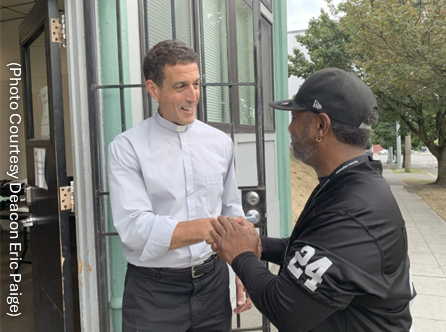
Archbishop Etienne authorizes Deacons in the Archdiocese of Seattle to Wear the Roman Collar when in Active Ministry.
On December 26th, the Feast of St. Stephen the Martyr, Archbishop Etienne updated our Archdiocesan policies permitting “permanent deacons to wear gray clerical shirts when actively engaged in ministry in a public setting.” Archdiocesan policy had previous prohibited the wearing of the Roman collar by deacons, except for special situations like street ministry with the express permission of the Vicar for Clergy Office.
Some deacons requested and received that permission. Their experiences ministering on the streets of Seattle raised the idea for this change. “Originally, wearing the Roman collar when on the streets was about ensuring our safety. But then we discovered that wearing the collar while serving those on the margins created the opportunity for encounters that would never happen otherwise. We asked, why not make this possible in other settings like prison ministry, hospital ministry and committals?”
Before considering the proposal, Archbishop asked the Office of the Vicar for Clergy to consult deacons and priests throughout the Archdiocese and to consult with dioceses across the country. After extensive consultation, finding many benefits and few problems, Archbishop approved the policy change.
The new policy permits deacons to wear the Roman collar with a gray shirt when engaged in active ministry. Deacons are encouraged to exercise good judgment wearing of the collar and only do so when it will help their ministry.
In implementing this policy, the Archdiocese of Seattle joins an increasing number of dioceses that permit deacons to wear the Roman collar. Many of those dioceses, but not all, ask their deacons to wear gray shirts.
Most dioceses that implemented this policy found that people became familiar with deacons wearing gray shirts quite quickly. Those with questions about the new policy can consult the Frequently Asked Questions below or contact Deacon Eric Paige at eric.paige@seattlearch.org.
Frequently Asked Questions regarding Deacons Wearing Clerical Attire
Why did Archbishop update the policy? Permanent deacons permitted to wear the Roman collar in street ministry found wearing it significantly improved their ability to connect with people on the margins. By permitting deacons to wear the collar, we hope to increase the ability of deacons to minister to people with pastoral need.
Should deacons wear the Roman collar all the time? No. Deacons should only wear the collar while actively engaged in ministry.
Do deacons have to wear the Roman collar? No. Deacons are permitted to wear a Roman collar when in active ministry, but not required. Some may find that it helps in their ministry and others may not.
Will people confuse deacons with priests now that they can wear a Roman collar? This hasn’t been a problem in other dioceses. Deacons will wear gray shirts with the Roman collar which should help people tell the difference. In cases where a person calls a deacon “father” the deacon can clarify that he is a permanent deacon.
Since deacons are wearing gray shirts with the Roman collar, are priests still permitted to wear gray shirts if they like? Yes. Priests who like to wear a gray clerical shirt are still free to do so.
Who purchases the clerical shirts that deacons wear? Each deacon will purchase their own clerical shirts if they opt to wear them.
When does the policy go into effect? December 26th, 2026 the Feast of St. Stephen the Martyr one of the very first deacons.
An overview of the Sacraments of the Catholic Church and our parish's offerings of these Sacraments can be accessed via our Sacraments page.